Preeclampsia Prevention Education Module
Company
Maven Clinic
Timeframe
H2 2025 – H1 2026
Impact
55% engagement among at-risk members · 20.1% lift in aspirin use
Executive Summary
Pregnant Maven members at risk for preeclampsia weren't getting the information or nudge they needed to start a daily low-dose aspirin regimen, one of the highest-leverage interventions for reducing preeclampsia risk. I helped design and iterate on Maven's first clinical intervention module, pairing shortform education with a direct action prompt. The module reached 55% of at-risk members and drove a 20.1% lift in aspirin use among those who engaged.
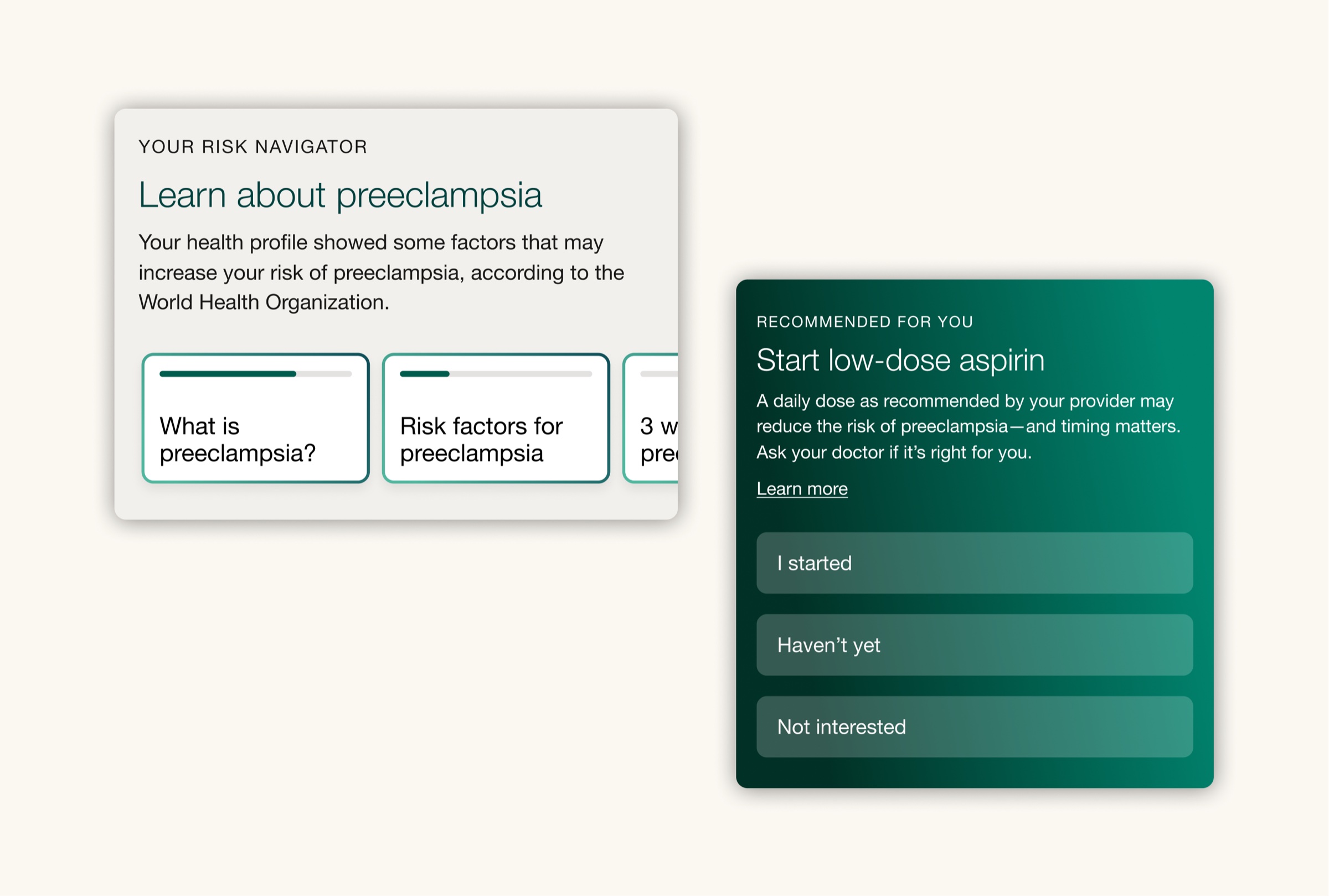
A close up of the shortform and action modules
Problem
Preeclampsia in pregnancy is a leading driver of preterm births and NICU admissions. A daily low dose of aspirin is one of the highest-leverage interventions available, reducing preeclampsia risk by roughly 15–28% and, with it, the downstream effects and costs of preterm birth and NICU care.
Maven members at risk of developing preeclampsia in pregnancy were not given any of this insight or guidance through our platform. And they certainly weren't starting to take low-dose aspirin on their own.
Opportunity
We had the opportunity to educate and empower at-risk members to understand what preeclampsia means for their pregnancy and give them a concrete, low-effort action — starting low-dose aspirin — to reduce their risk, while establishing a reusable pattern for future clinical interventions via Maven's platform.
Solving this was a high-stakes opportunity on every level: for members, closing this gap meant a real chance to reduce their risk and avoid a serious pregnancy condition. For Maven's clients, it meant real cost avoidance from the effects of preeclampsia (emergency C-sections and NICU stays, as top examples), and for Maven, it meant proving out the ROI the platform promises to paying customers.
Approach
We planned for a module with two parts: shortform story content to educate members about preeclampsia and its risks, and a direct prompt asking about aspirin use. We ran this as an A/B test from the start, so we could measure impact on aspirin initiation directly rather than assume it.
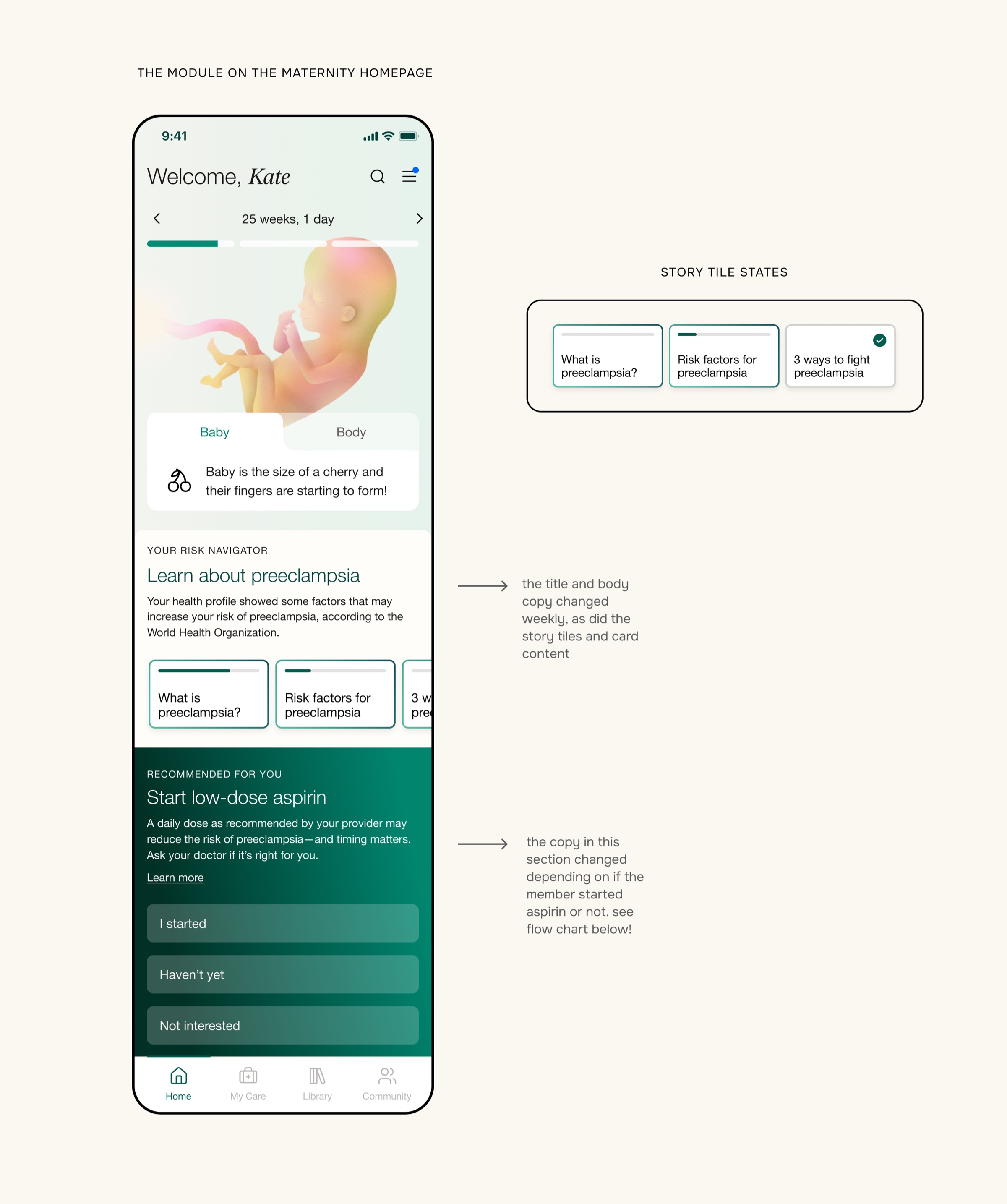
How the module fit into the home page. A look at the story tile entry points for the MVP of this project (the tiles were redesigned in a later iteration)
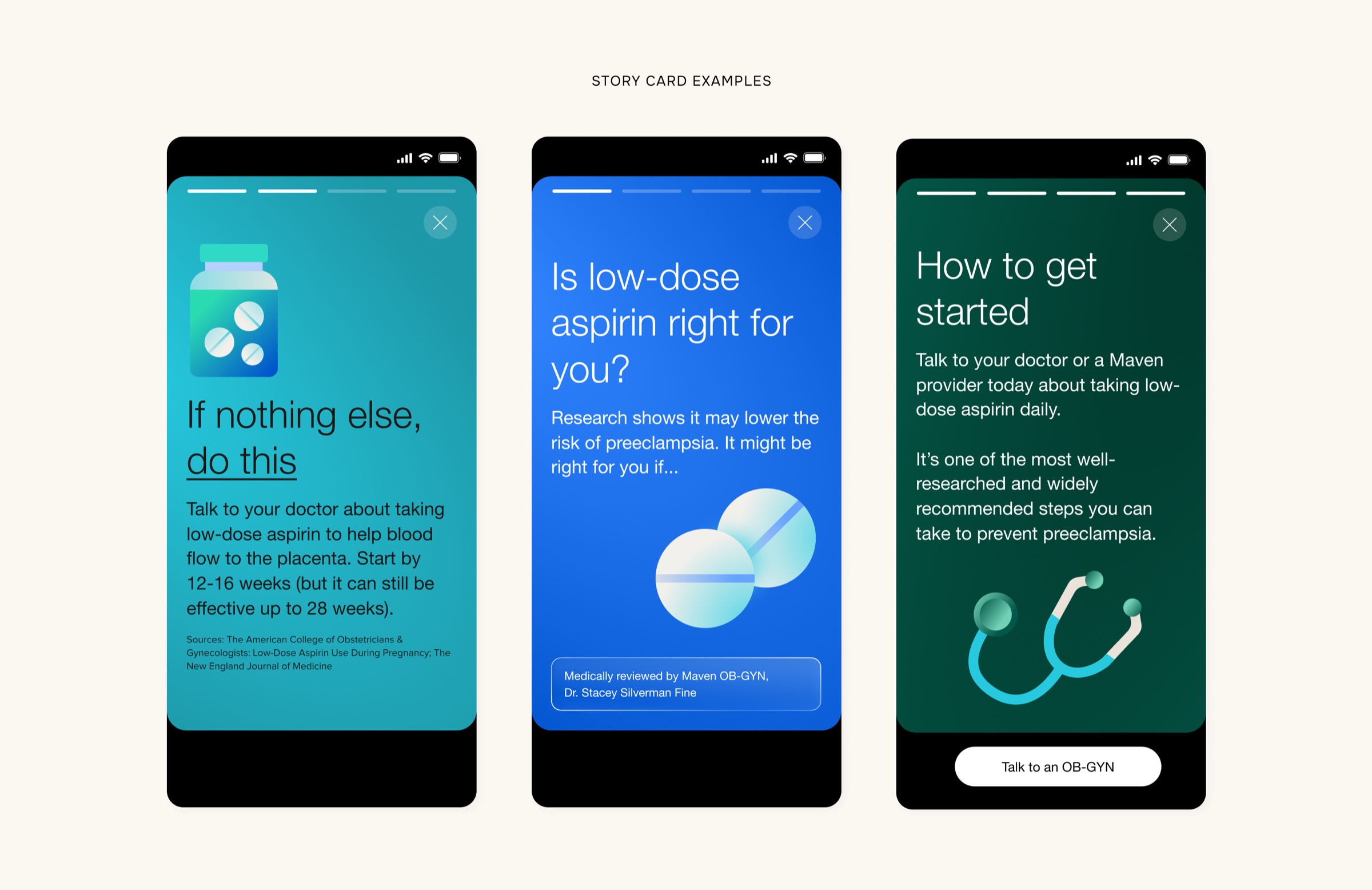
Story card examples
Process
I designed and iterated on both the education and action flows, testing copy and framing to reduce the sense of judgment in how the module asked about aspirin use. I refined the entry points and content structure based on engagement data as the module scaled from a limited rollout to full release.
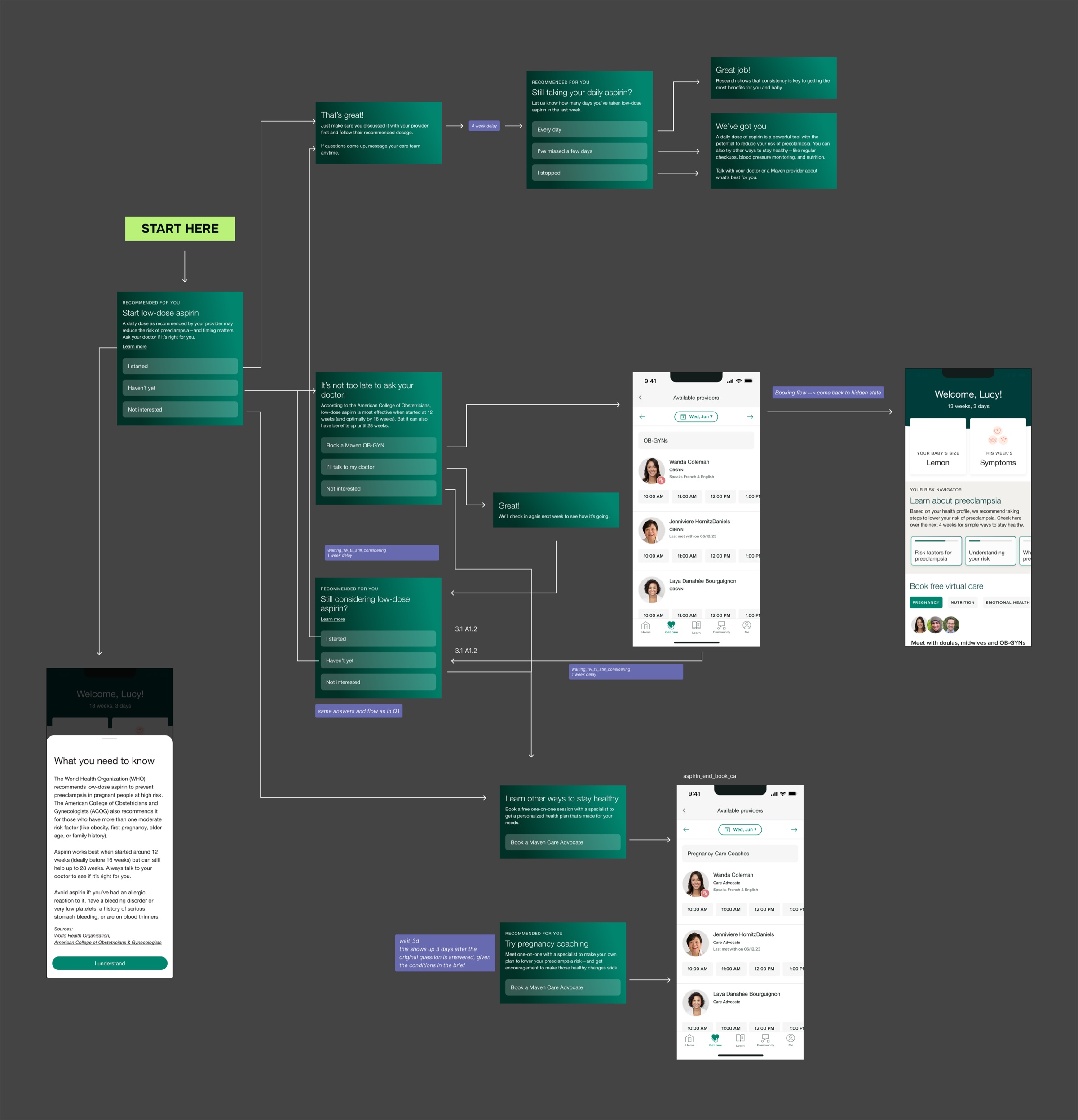
A flow chart describing the states of the action module
Constraints
Legal review shaped the copy significantly. Maven isn't permitted to diagnose members or tell them they're at risk for a specific condition, but the copy still needed real urgency, since preeclampsia's consequences are serious and members needed to understand the stakes. We worked closely with legal to land on language that conveyed that severity while staying within what Maven could legally say, with tradeoffs on both sides to get there.
Impact
55% of at-risk members who saw the module engaged with it. Among those who engaged, low-dose aspirin use reached 76.5%, compared to 63.7% among members never exposed to the module — a 20.1% lift. The module launched as a successful V1, and another designer later picked it up to iterate further on more engaging visuals for the story cards.